What Google Ads Actually Returns
for a Spa in India.
Not projections. Not industry benchmarks. Numbers from managing Google Ads for 50+ active spa clients across India since 2022. Ad spend comes from Google Ads Manager; attributed revenue comes from source-level billing reported by spa owners and managers.
Terminology: spa owners often search for “Google Ads ROI,” but the figures on this page are technically ROAS: Google Ads-attributed revenue divided by Google Ads spend.
The Numbers in Plain Terms
No marketing language. Just what the data shows.
How ROAS is calculated
Attributed Revenue ÷ Ad Spend
1:5 ROAS
₹5 in Google Ads-attributed revenue for every ₹1 spent on Google Ads.
1:19 ROAS
₹19 in Google Ads-attributed revenue for every ₹1 spent on Google Ads.
ROAS Range Across Active Spa Clients
Data from Google Ads Manager spend + owner-reported monthly billing
| Scenario | Monthly Ad Spend | Google Ads-Attributed Revenue | ROAS |
|---|---|---|---|
| Observed lower end | Account-specific | 5× ad spend | 1:5 |
| Documented example | ₹1,60,000 | ₹19,20,000 attributed | 1:12 |
| Highest observed | Exact figures not published | 19× ad spend | 1:19 |
The observed range across the managed client dataset is 1:5 to 1:19. The ₹1.60L → ₹19.20L example is shown separately because it equals 1:12, not 1:19. Attributed revenue comes from owner/manager source-level billing reports; ad spend is verified in Google Ads Manager. Results vary by location, competition, reception performance, offer, budget, and campaign maturity.
How a Rupee Spent on Google Ads Becomes Revenue for a Spa
For many spa accounts we manage, the conversion chain is different from e-commerce because bookings are completed by call, WhatsApp, or walk-in rather than an online checkout. Two common paths can lead to attributed revenue.
Search
"spa near me" or "body massage [area]"
Ad Shown
Your spa appears at the top of results
Customer Acts
Calls, WhatsApps, or walks in directly
Booking or Walk-in
Appointment confirmed or customer arrives
Revenue
Customer pays. Tracked via end-of-day manager reports.
How Revenue Is Measured
For many spa accounts we manage, bookings are completed over call, WhatsApp, or walk-in and payment happens at the front desk. Google Ads-attributed revenue is therefore tracked through end-of-day source reports submitted by spa managers or owners, alongside daily billing. Ad spend is verified directly in Google Ads Manager. ROAS is calculated monthly by comparing verified ad spend against owner/manager-reported billing attributed to Google Ads. This is source-attribution reporting, not automated e-commerce revenue tracking.
Google Ads Store Visit Conversions - All Spa Accounts Combined
Google Ads Manager view showing Store Visit conversions reported across active spa client accounts. January to February 2026.
Store Visit conversions in Google Ads are modeled and reported by Google using aggregated signals. They should be treated as Google Ads-reported modeled conversions, not as a literal headcount of every person who physically entered a spa.
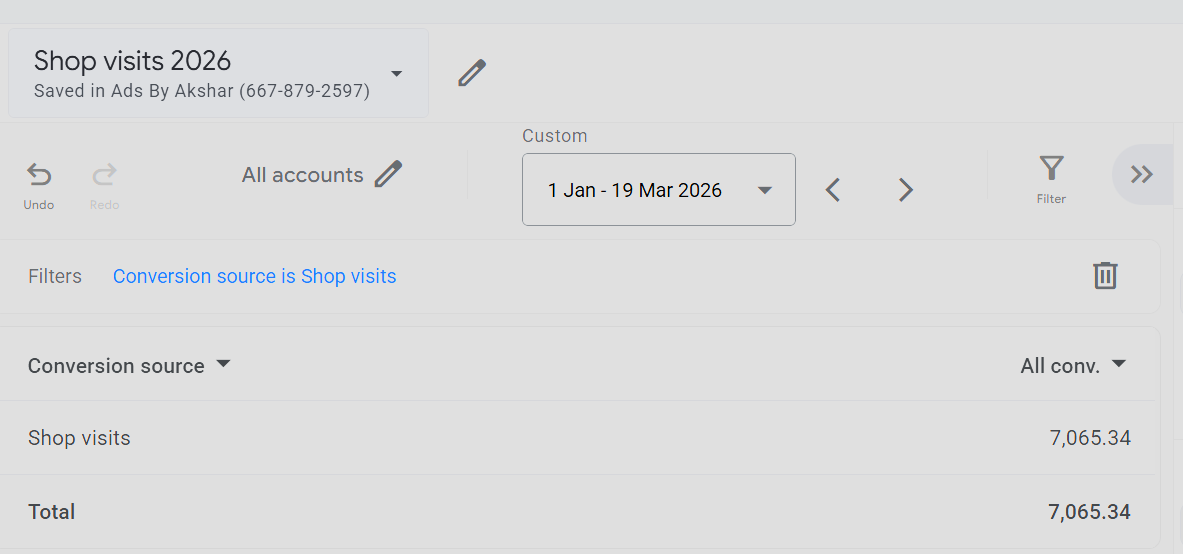
Screenshot from the Google Ads interface showing Store Visit conversions across active spa client accounts, 1 Jan to 19 Feb 2026.
Why the 1:5 Floor Applies After 3 Months
The first month rarely produces the best results. Here is what actually happens across those three months.
Month One
Campaign setup, keyword structure, location targeting, conversion measurement, and initial search-term data collection. Where automated bidding is used, the campaign or bid strategy may need time to calibrate as data accumulates. Leads may come in, but there is not yet enough account-specific evidence to call performance mature.
Month Two
Search terms report reviewed weekly. Negative keywords added based on junk search terms and client feedback on long-distance or irrelevant calls. Ad copy tested. Location radius tightened. Cost per lead starts dropping.
Month Three
By this stage, the campaign has a larger search-term history, a stronger negative-keyword list, location-quality feedback, and more conversion data. In the managed dataset described on this page, mature campaigns have shown ROAS from 1:5 upward, but individual results still vary.
Who These Numbers Apply To
Not every spa will see these results. Here is what the clients who do have in common.
Reception answers calls and WhatsApp promptly
Ads generate demand, but unanswered calls and slow WhatsApp replies can waste it. Reception responsiveness is one of the biggest operational variables we see affecting lead-to-booking performance.
Consistent monthly budget of ₹50K minimum
Below ₹50K, daily budget constraints limit how many high-intent searches your ad is eligible to show for.
Committed for minimum 3 months
Campaign optimisation compounds. Month one data improves month two. Month two data improves month three. The ROAS floor builds over time.
Good location in a city with search demand
We manage spa campaigns across multiple major Indian cities, including Hyderabad, Bangalore, Mumbai, Delhi, Pune, and Chennai. Search demand and viable radius differ by city and neighbourhood, so budget and targeting are adjusted location by location.
These results do not apply to spas that pause campaigns mid-month, change budgets weekly, or stop after 30 days
Campaign consistency matters. Frequent pausing, reactivation, and major budget or bidding changes can disrupt delivery and may cause automated bidding to recalibrate. Stable inputs make performance easier to evaluate and optimise.
Common Questions
Questions spa owners ask before starting.
Related Guides
Tell Me Your Spa and City
I will tell you what realistic ROAS looks like for your specific location and budget. No sales pitch. Every message answered personally by Akshar.