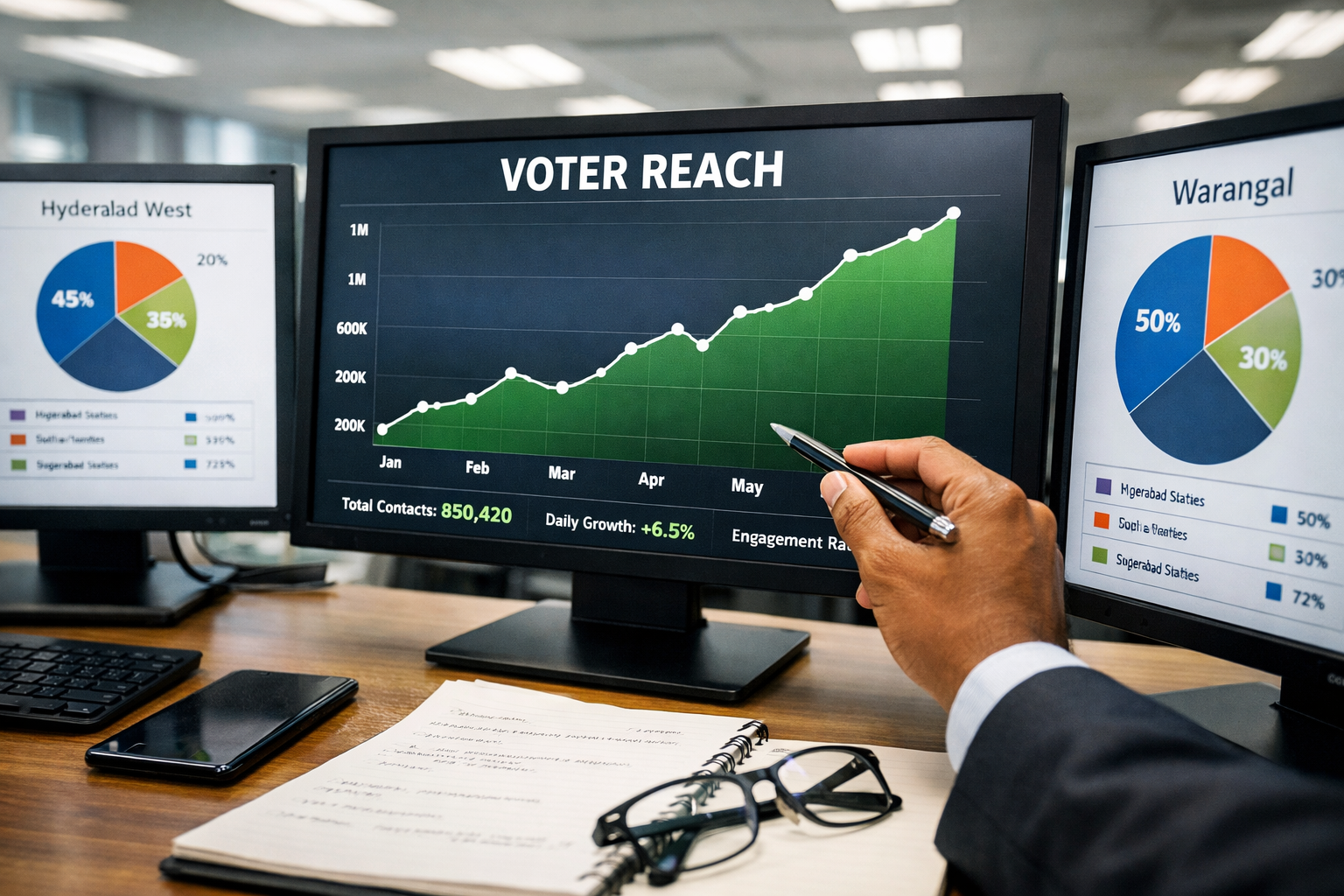
In Indian elections, the objective is simple: push narrative at scale without losing message discipline. The real battlefield is not the creative. It is delivery architecture.
Most campaign teams spend 90% of their time on slogans and visuals. The other 10% — timing, sequencing, impression flow, geographic concentration — is where elections are actually won or lost in the digital layer. A strong message delivered at the wrong time, to the wrong density, across the wrong platforms, becomes noise.
What follows is the execution framework we used. Budgets and candidate details remain confidential. The delivery numbers and the strategic logic behind them are not.
01
The Mindset Shift
Why Political Campaigns Measure Impressions, Not Conversions
Most digital agencies that come into election work bring performance marketing instincts. They optimize for clicks. They celebrate engagement rates. They run A/B tests on CTRs. They treat the campaign dashboard like an ecommerce store.
That is the wrong operating system entirely.
A voter is not a buyer. There is no purchase funnel. There is no retargeting window. The election happens on a fixed date and every impression that does not land before that date is permanently wasted. The entire logic of the campaign flips.
The fundamental difference
In commercial advertising, you optimize for the lowest cost per conversion and let volume grow from there. In political advertising, you optimize for the highest controlled reach within a defined geography and time window. The question is never "how cheaply can we get a click?" It is "how completely can we saturate the right audience before election day?"
This is why impression volume matters. 3.7 million Meta impressions and 968 thousand Google impressions across a defined constituency during an active election window are not vanity numbers. They represent structured frequency delivered to the voting-age population of that geography. That is the work.
02
Execution Framework
Delivery Architecture: The Six Things That Actually Determine Outcome
Political advertising in India is a logistics problem disguised as a marketing problem. Winning campaigns understand six things that losing campaigns treat as secondary.
01 — Timing
When to Deploy
Impression waves must align with voter attention windows. The week before polling day carries 3x the psychological weight of the week before that. Deploying budgets evenly across the campaign window is a common and expensive mistake.
02 — Geography
Where to Concentrate
Not all wards matter equally. Swing areas, high voter-density neighbourhoods, and areas with weaker ground presence need higher digital saturation. Budget allocation must reflect this, not be distributed uniformly.
03 — Frequency
How to Pace Delivery
A voter who sees the same ad 20 times in two days is tuning it out by day three. Frequency caps and creative rotation maintain presence without triggering fatigue. The goal is consistent visibility, not aggressive bombardment.
04 — Sequencing
Message Wave Structure
Awareness first. Narrative reinforcement second. Call-to-action (show up, vote) third. Each wave must land in rhythm with ground activity and media cycles. Out-of-sequence delivery breaks the psychological build.
05 — Platform Mix
Meta vs Google vs Both
Meta reaches you in your social feed — high emotional salience, high share potential. Google reaches you in your search intent — high credibility signal, lower emotional but higher rational influence. Both working simultaneously creates cross-channel reinforcement that neither achieves alone.
06 — Creative Discipline
Avoiding Narrative Drift
When 8 different creative teams contribute to a single campaign, the message fragments. Every visual, every line of copy, every call to action must reinforce one central narrative. Creative variety within message consistency is the standard. Creative variety that introduces multiple competing narratives is fatal.
04
The Execution
How Real Indian Election Campaigns Are Run — Mayor, MLA, and MP
The execution framework applies across election tiers — Mayor, MLA, and MP — with the same structured delivery sequence. Constituency size and budget scale differ, but the architecture is identical. Campaign objectives were set to reach and impressions, not conversions. Geographic targeting was restricted to the specific constituency boundaries. Frequency caps were applied to prevent oversaturation. Creative rotation was managed to maintain message freshness without narrative drift.
01
Constituency Mapping and Audience Sizing
Before a single ad runs, the geography is defined precisely. Ward boundaries, voter density by area, and platform audience size estimates are verified. This determines realistic impression targets and budget requirements to achieve meaningful frequency within the constituency.
02
Campaign Structure: Awareness Wave First
The first phase builds name and face recognition. Broad reach, high impression volume, simple messaging. The goal is ensuring that when the voter encounters the candidate's name elsewhere — on a hoarding, in a newspaper, at a rally — it is already familiar. Familiarity breeds credibility at scale.
03
Narrative Reinforcement Phase
Mid-campaign delivery shifts to issue-based and achievement-based messaging. The voter who has seen the candidate's face now sees their work. This is where the psychological build happens — awareness converts to association. The creative work here is more demanding because it must communicate substance, not just recognition.
04
Final Push: Concentrated Impression Spike
The final 48 to 72 hours before polling carry disproportionate weight. Budget is concentrated here. Frequency caps are relaxed slightly. Geographic targeting may narrow to the highest-impact wards. The creative message shifts to direct voter action. This is the phase that most underfunded campaigns handle poorly — they exhaust their budget too early and go dark exactly when presence matters most.
05
Real-Time Delivery Monitoring
Impression pacing is monitored daily. If Meta delivery is under-pacing due to auction competition, Google budgets are adjusted to compensate. If a specific ward shows weak delivery, geographic bid adjustments are made. Election advertising is not a set-and-forget operation. It requires daily active management from the first day to polling day.
Reach is not the enemy. Uncontrolled reach is. The difference between a loud campaign and an effective one is sequencing. Message waves must land in rhythm.
05
Common Mistakes
What Most Digital Agencies Get Wrong in Election Campaigns
The majority of digital agencies that take on election work are fundamentally misaligned in how they think about the campaign. The instincts that make a good performance marketer make a poor political advertising manager.
Mistake 01
Optimising for Clicks
Clicks are not votes. A voter who clicks your ad and reads it is not statistically more likely to vote for you than a voter who saw it three times and scrolled past. Impression frequency in the right geography matters. Click volume is largely irrelevant.
Mistake 02
Budget Front-Loading
Spending 60% of the campaign budget in the first two weeks and tapering off as polling day approaches is a structural error. Voter attention and recall are highest in the final week. The budget distribution should reflect that, not contradict it.
Mistake 03
Ignoring Frequency Caps
An ad seen 30 times by the same voter generates resentment, not persuasion. Frequency without caps creates negative brand recall — the opposite of what the campaign needs. Frequency must be controlled and distributed across a wider audience, not concentrated.
Mistake 04
Generic Geographic Targeting
Targeting the entire city or district when the election is for a specific ward or constituency is wasted spend. Every impression delivered outside the actual voting area is a rupee that cannot influence a single vote. Geographic precision is not optional in election work.
The bottom line: In elections, you are not running ads. You are managing narrative infrastructure. The tools are the same as commercial advertising. The operating logic is entirely different. Agencies that understand this difference are rare. Agencies that have executed it across live election windows are rarer.
Planning a political campaign?
WhatsApp me. All discussions are strictly confidential.
WhatsApp Me
Common Questions
Things political campaign teams ask when they find this page.
How do political campaigns in India use Meta Ads?
Political campaigns use Meta Ads primarily for impression-based reach campaigns during active election windows. The objective is controlled frequency delivery — ensuring the campaign message reaches the right geographic audience repeatedly within the election period. Campaigns are structured around impression flow, timing, and geographic concentration rather than performance metrics like clicks or conversions.
What is the difference between political advertising and performance advertising?
Performance advertising optimises for conversions, leads, or sales. Political advertising optimises for psychological presence — ensuring a candidate's narrative reaches voters with sufficient frequency to influence awareness and recall. The metrics that matter in political campaigns are reach, frequency, impression distribution across geographies, and message sequencing. Click-through rates are largely irrelevant.
Can Google Ads be used for election campaigns in India?
Yes. Google Ads, including YouTube, Display, and Search, are used in Indian election campaigns to extend reach beyond Meta. Google's inventory covers users across Search, Maps, YouTube, and the Display Network, allowing campaigns to maintain presence across multiple touchpoints during the election window. Proper verification and compliance with electoral advertising policies is required before running.
What makes political advertising different from regular digital marketing?
Political advertising in India is fundamentally a logistics and delivery problem. The election window is fixed, the geography is defined, and the audience is the entire voter base in a constituency. Unlike commercial campaigns where you target buyers, political campaigns need to reach everyone in a defined area with controlled frequency. Timing, sequencing, impression pacing, and narrative discipline matter more than creative performance.
Does Ads By Akshar run political election campaigns in India?
Yes. Ads By Akshar has executed political advertising campaigns in India across multiple election tiers — Mayor and Municipal elections, MLA and Vidhan Sabha elections, and MP and Lok Sabha elections. Campaigns have been managed across Telangana and other states for multiple candidates. All candidate names, budgets, and campaign details remain strictly confidential. Delivery outcomes like impression volumes are the only numbers disclosed publicly. To discuss a campaign, WhatsApp directly — all conversations are confidential.
More From Ads By Akshar
Real campaigns, real data, real results.